To fly commercially, or for compensation, you need at least a Commercial Pilot Licence (CPL). A CPL allows you to hold the position of captain on aircraft weighing up to 5700 kg or with fewer than 19 passenger seats.
This course is designed for people who want a career as a professional pilot. For example, besides progressing to large-scale aviation, you can also consider a position as a flight instructor or performing advertising and sightseeing flights. At Breda Aviation, we combine the CPL with the MEP.
With a CPL, you also have the option to add an Instrument Rating (IR) and fly IR commercially.
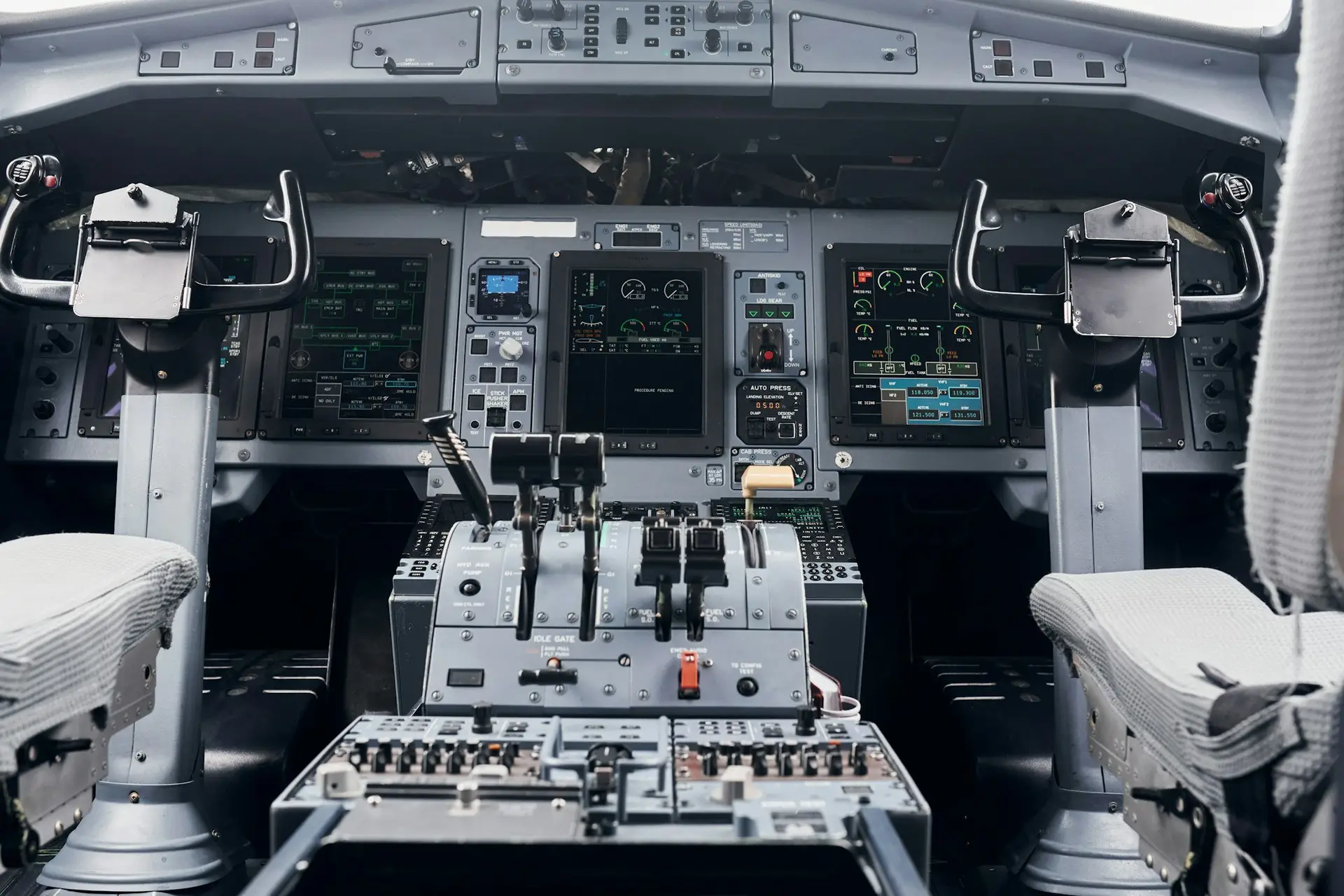
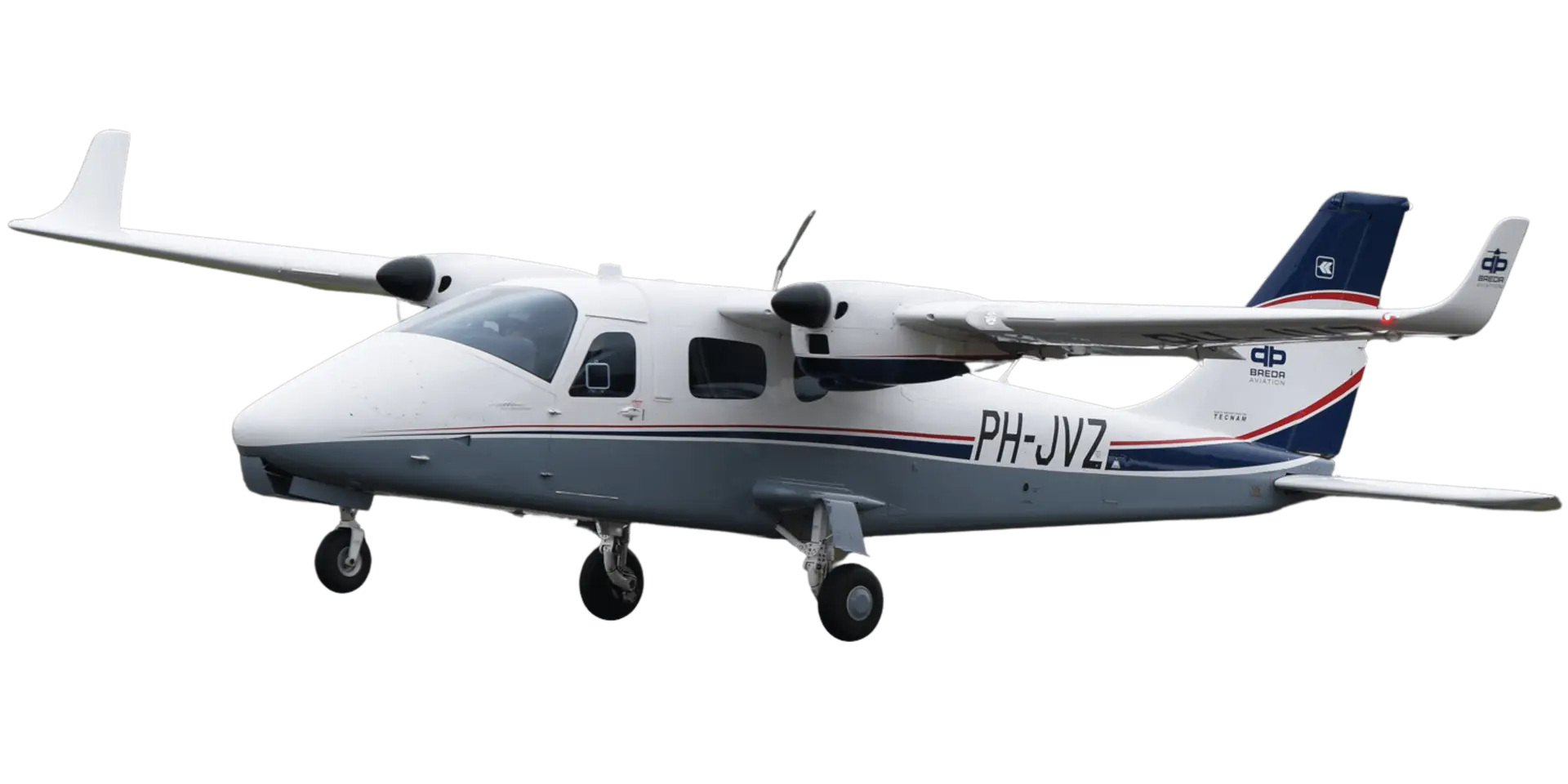
For this training, we use our twin-engine aircraft, the Tecnam P2006T and our certified P2010 Simulator. In addition, it is also possible to obtain your CR-MEP (Multi Engine Piston) on our Tecnam P2006T.
Why the CPL on a Multi-Engine aircraft? The reason is that for your CPL, you need to fly on a 'complex' aircraft. Within our fleet, the P2006T meets the requirements for a complex aircraft.
The aim is to make you a commercial pilot who makes the right choices in terms of airmanship.
During practical lessons, we build on the PPL. Now with tighter requirements on the flying itself. Alongside this, we address the effects of the commercial incentive in making decisions and pay attention to UPRT (Upset Prevention Recovery Training).
A CPL licence is your entry ticket to a career as a professional pilot. Whether you want to become an instructor, conduct charter flights or progress to ATPL - this course will lay the right foundation. You get out:
A official commercial pilot licence (CPL)
Practical experience with complex flights and navigation
Professional guidance and preparation for commercial functions
Skills directly applicable in the aviation sector
The freedom to make your passion your job
At Breda Aviation, we put you first, so that you not only achieve the CPL training, but also take full advantage of it.
For our CPL/ATPL theory, we work with Distance learning. We partner with Orbit Groundschool for this purpose. Orbit has an online system based on BSG (Bristol Ground School) where you take the Progress Test (PT) remotely via Orbit Groundschool and you take an online brush-up. Once you have successfully completed the PT and brush-up, you can take exams on site at Orbit Groundschool through Austro Control.
In addition, it is also possible not to take the exams at Austro Control, but to take your exam at the CBR.
The Private Pilot Licence (PPL) allows you to fly as a private pilot for recreational purposes, without financial compensation. A PPL allows you to bring friends and family, but commercial flights are not allowed.
The Commercial Pilot Licence (CPL), on the other hand, gives you the authority to fly for pay. This means you can work as a professional pilot, for example as a flight instructor, to carry out advertising flights, sightseeing flights or other commercial activities. A CPL allows you to hold the position of captain on aircraft weighing up to 5,700 kg or with fewer than 19 passenger seats.
The cost of a CPL course varies depending on several factors, such as the flight school, the type of aircraft and the duration of the course. At Breda Aviation, CPL training is tailor-made, where you pay per lesson taken. This offers flexibility and prevents you from having to invest a large amount in one go. For a detailed cost estimate, it is best to contact Breda Aviation directly.
To start the CPL course at Breda Aviation, you must meet the following requirements:
A total of 200 flight hours is required to issue the CPL certificate.
The duration of the CPL course depends on your availability and the number of lessons you can take per week. At Breda Aviation, training is offered on a modular basis, which means you can study at your own pace. On average, obtaining a CPL takes between 6 and 12 months, but this can vary based on individual circumstances.
With a CPL licence, you can work professionally in aviation. Possible careers include:
In addition, the CPL is an essential step towards a career as a commercial pilot with an airline.
Yes, obtaining a CPL is a necessary step towards a career as a commercial pilot. In addition to the CPL, you also need to pass the Airline Transport Pilot Licence (ATPL) theory and take additional training courses, such as Multi-Crew Cooperation (MCC) and Instrument Rating (IR), to be fully qualified for airline line flying.
Yes, after obtaining your PPL, you can proceed directly to CPL training, provided you meet the entry requirements mentioned earlier, such as the required number of flight hours and Class I medical examination. It is common practice to accumulate flight hours after obtaining the PPL to meet the CPL requirements.
Before starting CPL training, you need to have a minimum of 150 flying hours, including 50 hours as Pilot in Command (PIC) and 10 hours cross-country. A total of 200 flight hours is required for the issuance of the CPL certificate. During the training itself, a minimum of 25 practical hours are flown, including 10 hours of Basic Instrument flying and 15 hours of flying on a complex aircraft.
Yes, a CPL issued by an EASA-certified flight school, such as Breda Aviation, is valid in all EASA member states. This means you can operate commercial flights throughout Europe with this licence. Work outside Europe may require additional requirements or conversions, depending on local regulations.
Breda Aviation offers a modular CPL course, giving you the flexibility to follow the course at your own pace. This is ideal for students who want to combine training with work or other commitments. Breda Aviation is known for its personal approach, modern fleet and experienced instructors, contributing to a high-quality training experience.
If you're all set, you can of course register straight away. Still have questions? Take a look at our FAQ page or contact us, we will be happy to help.
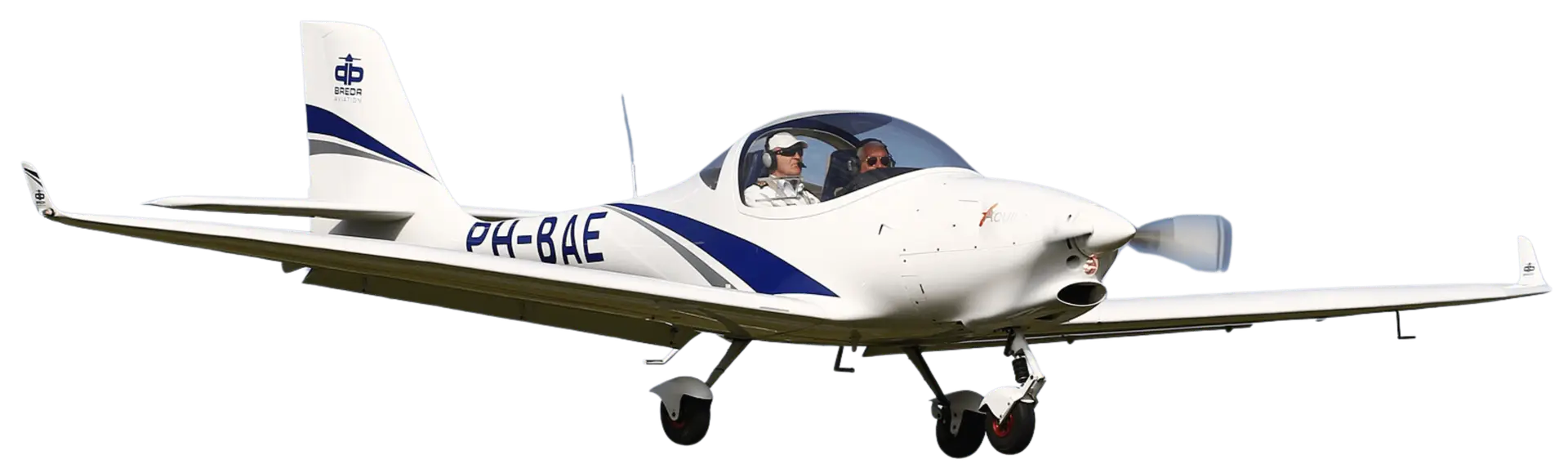
Basically, your CPL training starts with obtaining your PPL (Private Pilot Licence). We use the Aquila A211 for this purpose. This is a modern two-seater in which all PPL practice can be flown. This low-decker is equipped with modern avionics and a spacious open cockpit.
Apart from this, there is also the option to get your PPL on the Tecnam P2010. This is a very complete and modern high-decker. This aircraft is also used for the Instrument Rating (IR) part of the CPL training.